
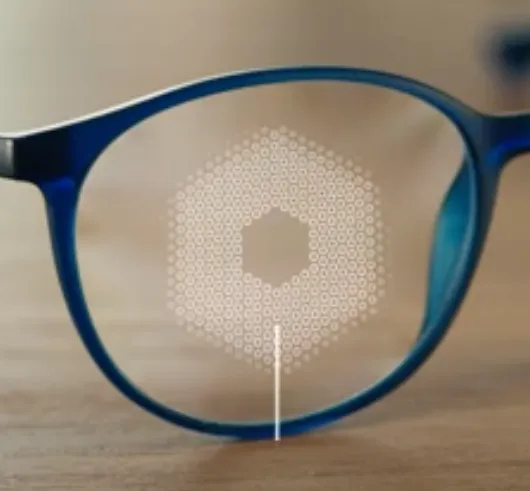
Both Essilor Stellest and Hoya MiYOSMART have been updated. Stellest 2.0 (H.A.L.T MAX) and MiYOSMART iQ (D.I.M.S. TED) are the next generation of the two lenses I already compared in my Stellest vs MiyoSmart post: same idea, stronger defocus.
What’s actually changed in the design
Stellest 2.0 extends the treatment zone from 11 rings to 12, and the defocus power is around twice the depth of the first generation.
MiYOSMART iQ increases the defocus power from +3.50D to +4.50D, extends the outer band of defocus segments, and adds an inner ring of segments that wasn’t there before.
Both lenses are still using the same underlying approach as their first generation, using myopic defocus at the periphery, clear vision in the centre. This is a stronger version of the same technology, not a different one.
Clinical efficacy results
In a 50-child crossover trial, Stellest 2.0 showed a 59% increase in efficacy at 6 months, and 46% at 12 months, compared to the first-generation lens.
MiYOSMART iQ showed an 85% increase in efficacy at 6 months, in a study of 199 children.
MiYOSMART iQ’s 12-month results
This is where it gets interesting. Over 12 months, single vision lenses (no myopia control at all) showed -0.53D of progression. The eye continued to get more short-sighted, as expected. MiYOSMART iQ children showed +0.05D: essentially no further progression, and technically a very slight improvement.
Axial elongation (the eye physically growing longer, which is what actually drives myopia getting worse) was reduced by around 78%. 9 in 10 children on MiYOSMART iQ had their progression halted to the point it was no longer clinically relevant.
Want to see the lenses side by side?
I find the ring pattern easier to understand once you can actually see it, rather than just reading the numbers above. This video walks through how Stellest 2.0 and MiYOSMART iQ compare:
Why this works: the choroid
The mechanism behind both lenses, and why the newer versions are stronger, comes down to the choroid. That’s the vascular middle layer of the eye, between the retina and the sclera (the white outer wall). Effective myopia control treatments stimulate the choroid to thicken, which helps regulate how much the sclera overgrows. A thicker choroid is associated with slower axial elongation. That’s the biological reason a stronger defocus signal translates into a stronger clinical result.
Should you switch your child to the newer lens?
If your child is already in Stellest or MiYOSMART and progressing well, there’s no urgency to change anything. If they’re due for a new pair, or progression hasn’t slowed as much as we’d like on the first-generation lens, the newer versions are worth discussing at your next myopia management review. Book in and we can go through their axial length and progression history together to decide what’s actually right for them.
Let’s take care of your eyes!

15 years of experience as an optometrist and owner of Carina Eye Care, experienced in prescribing the full range of myopia management options.
Written and medically reviewed by Dr Carina Trinh, BOptom · AHPRA Registered (OPT0001663121) · Optometry Australia Member · CCLSA Member · OSO Member · IOA Member.